Documentation Index Fetch the complete documentation index at: https://danswer-mintlify-deep-research-1773355783.mintlify.app/llms.txt
Use this file to discover all available pages before exploring further.
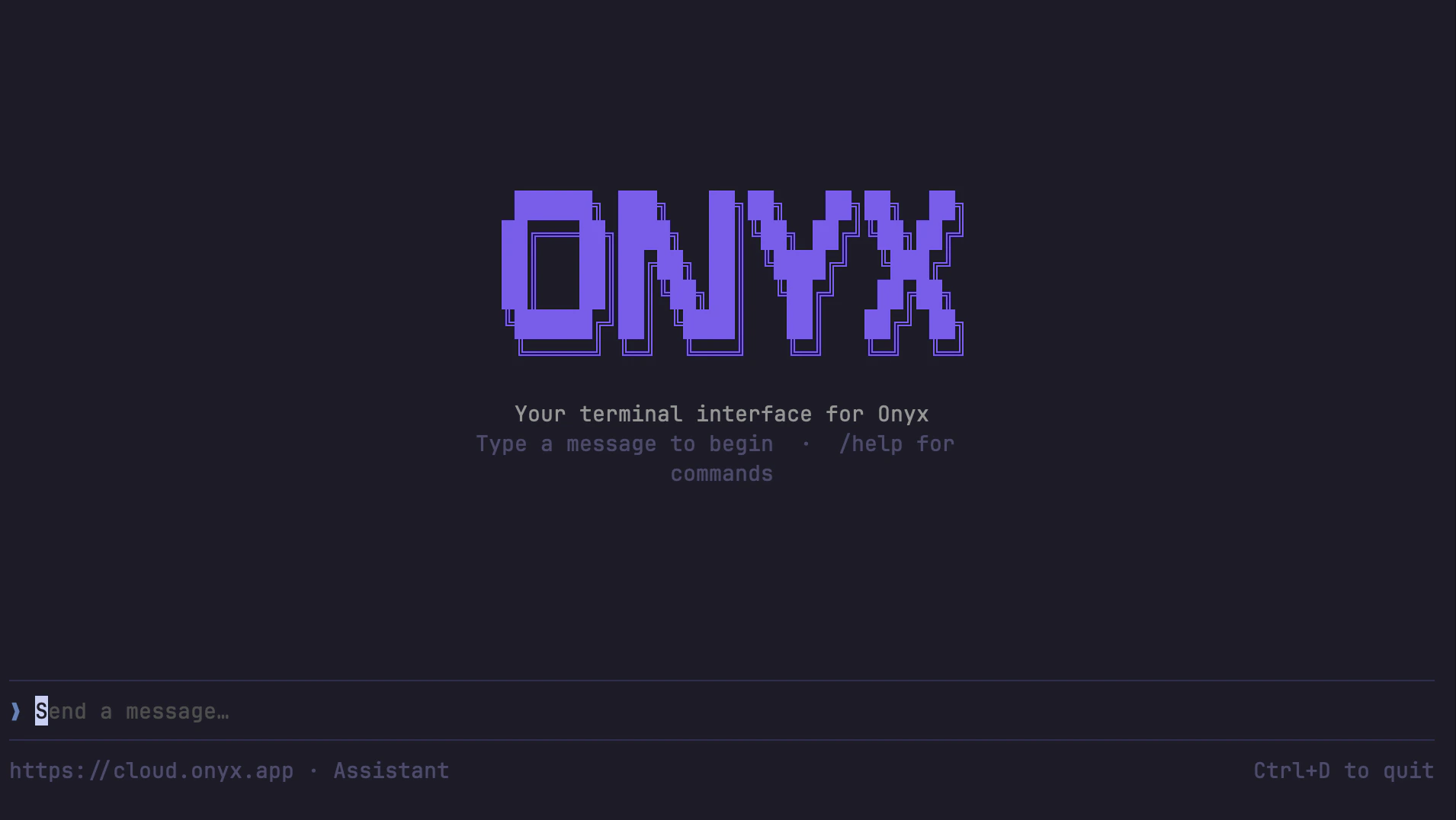
The Onyx CLI is a terminal interface for chatting with your Onyx agents and querying your knowledge base.
Built with Go using Bubble Tea ,
it provides both an interactive TUI and non-interactive commands for scripting and automation.
Installation
PyPI (recommended)
Or with uv:
PyPI Package pip install onyx-cli
go install github.com/onyx-dot-app/onyx/cli@latest
Build from Source
Requires Go 1.24+ .
git clone https://github.com/onyx-dot-app/onyx.git
cd onyx/cli
go build -o onyx-cli .
sudo mv onyx-cli /usr/local/bin/
Setup
Run the interactive setup to configure your server URL and API key:
This prompts for your Onyx server URL and API key, tests the connection,
and saves config to ~/.config/onyx-cli/config.json.
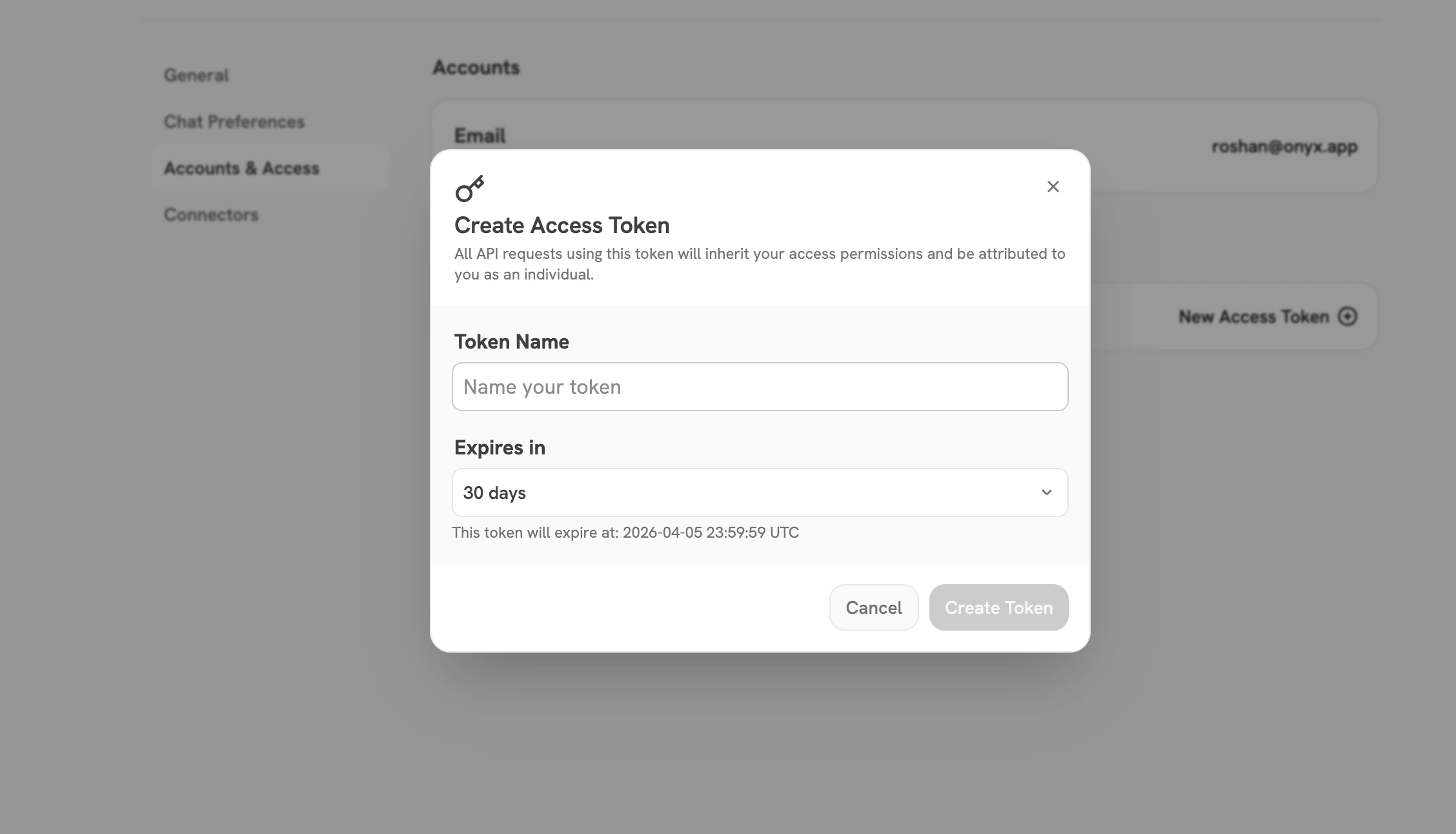
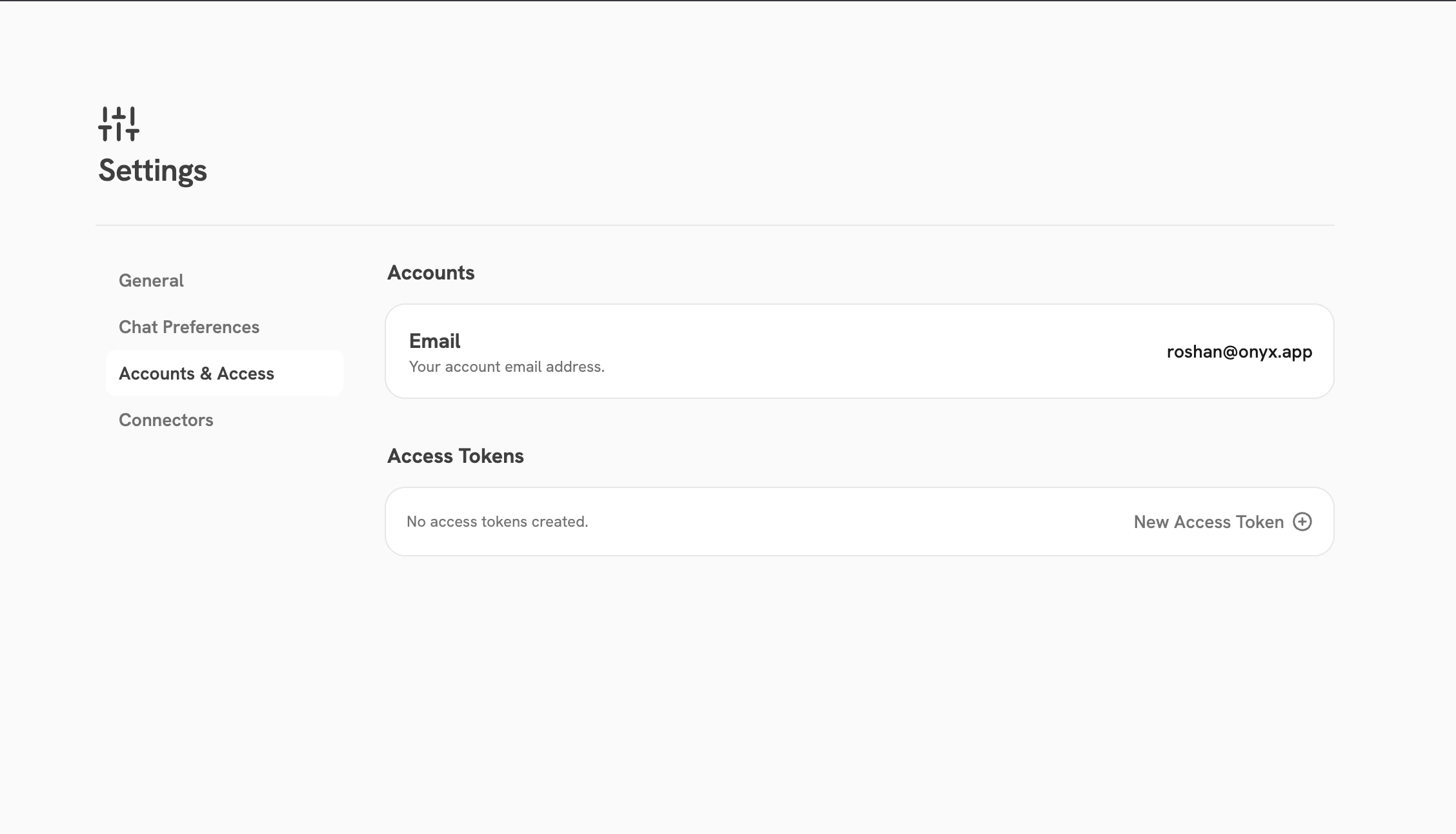
Generating an Access Token
Navigate to User Settings > Accounts & Access > New Access Token (/app/settings/accounts-access)
to create an access token for the CLI.
Environment Variables
Environment variables override config file values. This is useful for CI/CD pipelines and scripting.
Variable Required Description ONYX_SERVER_URLNo Server base URL (default: https://cloud.onyx.app) ONYX_API_KEYYes API key for authentication ONYX_PERSONA_IDNo Default agent/persona ID
Validate Configuration
Verify that your configuration is correct and the server is reachable:
Commands
Command Description onyx-cliLaunch the interactive chat TUI (default) onyx-cli askAsk a one-shot question (non-interactive) onyx-cli agentsList available agents onyx-cli configureConfigure server URL and API key onyx-cli validate-configValidate configuration and test connection
Interactive Chat
Opens a full-screen terminal UI for conversational interaction with your Onyx agents.
One-Shot Questions
Ask a question and get a response without entering the TUI:
onyx-cli ask "What is our company's PTO policy?"
Use --agent-id to target a specific agent:
onyx-cli ask --agent-id 5 "Summarize our Q4 roadmap"
Use --json for structured NDJSON output (useful for scripting):
onyx-cli ask --json "List all active API integrations"
Flag Description --agent-id <int>Agent ID to use (overrides default) --jsonOutput NDJSON events instead of plain text
List Agents
onyx-cli agents
onyx-cli agents --json
Prints a table of available agent IDs, names, and descriptions.
Slash Commands (Interactive TUI)
When using the interactive chat, the following slash commands are available:
Command Description /helpShow help message /newStart a new chat session /agentList and switch agents /attach <path>Attach a file to next message /sessionsList recent chat sessions /clearClear the chat display /configureRe-run connection setup /connectorsOpen connectors in browser /settingsOpen settings in browser /quitExit Onyx CLI
Using as an AI Coding Assistant Skill
The Onyx CLI can be used as a tool by AI coding assistants (such as Claude Code and Cursor)
to query your knowledge base directly from within your development environment.
A pre-built skill definition is available in the Onyx repository at
.cursor/skills/onyx-cli/SKILL.md .
Once configured, the AI assistant can call onyx-cli ask to look up company-specific information — policies,
internal docs, connected data sources — without leaving the editor.
When the skill is invoked
The skill is triggered when you ask your AI assistant about:
Company-specific information (policies, processes, documentation)
Internal knowledge bases or connected data sources
Anything referencing Onyx, “search Onyx”, or querying company documents
It is not used for general programming questions or questions about code in the current repository.
Configuration for agents
The simplest approach is to run onyx-cli configure once manually — after that,
AI assistants can invoke onyx-cli ask directly without any additional setup.
Alternatively, you can configure via environment variables,
which override the config file and are useful for CI/CD or sandboxed environments:
export ONYX_SERVER_URL = "https://your-onyx-server.com"
export ONYX_API_KEY = "your-api-key"
JSON output for structured parsing
Use --json to get NDJSON event output, which is easier for agents to parse programmatically:
onyx-cli ask --json "List all active API integrations"
Event Type Description message_deltaContent token — concatenate all content fields for the full answer stopStream complete errorError with error message field search_tool_startOnyx started searching documents citation_infoSource citation with citation_number and document_id
Keyboard Shortcuts
Key Action EnterSend message EscapeCancel current generation Ctrl+OToggle source citations Ctrl+DQuit (press twice) Scroll / Shift+Up/DownScroll chat history Page Up / Page DownScroll half page